This newsletter is designed to give you researched backed skills to improve your mental, emotional and relational lives.
Is multi-tasking in your work costing you? or helping you?
|
"What we choose to focus on and what we choose to ignore plays in defining the quality of our life." — Cal Newport Hey all, When I got to Kansas State, I decided I was going to finish my degree in three years instead of four. Not entirely sure why... prolly a combination of ambition, stubbornness, and a genuine dislike for taking out student loans every semester. It felt like a challenge at the time, so I went after it. That meant five consecutive semesters of 22-plus credit hours. Back to back to back to back. Six or seven classes at a time, part-time work at the rec center wiping down equipment, and a social life I was not willing to sacrifice. What got sacrificed instead was sleep. I slept so poorly that I eventually just accepted I was going to fall asleep in class. My solution: a recording app on my iPad. I'd show up, hit record, fall asleep, & listen to the lecture at 2x speed later. It worked until my Abnormal Psych professor, Dr. Mark Burnett, called me out mid-lecture for sleeping. The humorous part... I didn't even hear it happen. I had to listen to it on my iPad later to catch his frustration with me. I was pretty embarrassed. So I graduated in three years. Got the degree. Then moved to Kansas City to start my career in mental health. What I didn't realize until years later was that I had also built a set of habits that were really bad for me outside of that environment. I had trained my brain to operate in permanent fragmentation mode:
In the real world, my strategy broke down. Not all at once, but gradually. Whatever was in front of me got a partial version of me. I thought I was being good at "volume" but really I was jsut getting worse at achieving depth. Dr. Cal Newport take on Multitasking & the 23 Minute Rule
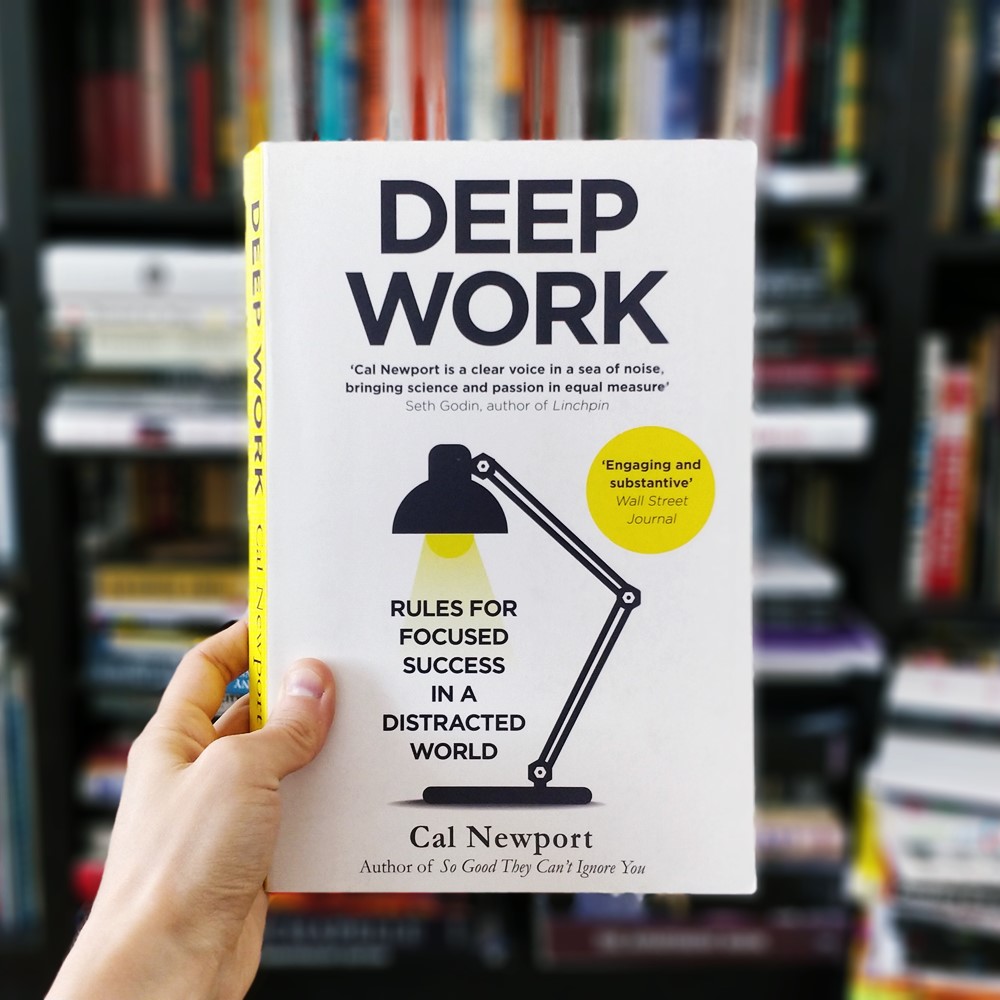
Cal Newport, a computer science professor at Georgetown and the author of Deep Work, states: multitasking (doing two cognitively demanding things simultaneously) does not exist. What we call multitasking is actually task switching. And task switching is pretty cognitively demanding. Forty percent! For example... Think of it like a computer with forty tabs open. The computer is not running forty programs at full capacity. It is running forty programs badly, everything loading slower, the whole system heating up, nothing performing the way it was designed to. When you switch tasks, your brain has to disengage from the previous context, load the new one, and reorient — a process researchers call the "attention residue" effect. Newport describes attention residue this way: when you switch from Task A to Task B, part of your attention stays stuck on Task A. You are physically at Task B but mentally you are still partially at the last thing. The faster and more frequently you switch, the more residue accumulates — and the shallower your thinking becomes across everything. Studies show it takes an average of 23 minutes to fully regain deep focus after an interruption. Twenty-three minutes. For most of us, another interruption arrives long before that window closes. Here is the working link to the paid tier of MH4M Newsletter: Introducing: Monotasking (i.e. Deep work)Deep work is not a productivity hack, morning routine or a focus app. It is the deliberate practice of giving one thing your complete, undivided attention. This is what I call Monotasking with my clients. When we work theres 2 categories for focus we can be opperating in:
Shallow work — logistical tasks that can be performed while distracted. Emails. Scheduling. Routine responses.
Deep work — cognitively demanding, high-value tasks that require full concentration.
Most of us spend the majority of our time doing shallow work while telling ourselves we are being productive. "A deep life is a good life." — Cal Newport A Tool to Begin Incorporating Deep Work/Monotasking:Newport has went to an elite level of this. He will sometimes work off a type-writer to avoid distractions, no social media, and sound proof office space. I on the other hand normally am working with 2 young children around, multiple jobs, running a campaign, and multiple sources of background noise. However, Newport's research really helped me structure my work differently, which is worth sharing with you. Step 1: Stop Attempting Two Things at Once Accepting multitasking is a myth will help you be more productive than that new app or planner. You have to commit to monotasking with every task you approach. Every time you are in a meeting half-composing an email, you are doing both badly. Pick one. Do it. Then do the next one. This sounds obvious. It is remarkably hard to actually practice. Start by noticing how often you are attempting to split your attention and what it costs the thing in front of you. Step 2: Protect One Hour of Deep Work Per Day Newport's research suggests that even one to four hours of genuine deep work per day, produces disproportionate output compared to an entire day of fragmented shallow work. BOOK THESE ON YOUR CALENDAR! I will do this with writing content for this newsletter, writing my students messages back, and planning for the upcoming year. Step 3: Batch Shallow Work Email, scheduling, administrative tasks, phone calls — batch them into designated windows instead of letting them interrupt your entire day. I struggle with this because I'm an "inbox 0" guy. When I look at my screen time report typically gmail is my highest logged time -- so lame. The goal is not to be less responsive. It is to stop letting other people's urgency determine where your attention goes all day long. Step 4: Use a Shutdown Ritual Newport writes about a deliberate end to the workday that signals to your brain that cognitive tasks are done and it is time to actually be somewhere else. I struggle with this one. As a therapist a lot of sessions live in my head while I drive home and am at home. The most helpful ritual I have found is to do something kinetic. Go for a walk, work out, change out of work clothes, anything that signals transition from work can be helpful. Stay connected, Zach Clinical Therapist and Founder of Mental Health 4 Men |
Mental Health 4 Men
This newsletter is designed to give you researched backed skills to improve your mental, emotional and relational lives.

Hey all, I want to tell you about something that happened right here in Kansas this past Fourth of July that has really impacted me. But first I want to set the scene... Imagine you are 19 years old and you sign up to serve your country. You do the training. Then you deploy. And for the next eight, twelve, maybe sixteen months, your entire nervous system gets rewired around one singular biological imperative: survive. Loud noises start to become potential threats. Unfamiliar vehicle on the...
"Attachment is a unifying principle that reaches from the biological depths of our being to its furthest spiritual reaches." — Jeremy Holmes, Hey All! There’s an Harvard experiment from the early 1970s that has really shaped the way I approach each client I work with in session called “The Still Face Experiment”. A mom sits with her baby. They’re playing. Smiling. Locking eyes back and forth in that normal rhythm of connection. Then, on cue, the mom’s face goes still. Blank she stops...

Over 900 new subscribers joined this past month! Welcome! If you want to go deeper, we launched a paid tier where a portion of every subscription goes directly to domestic violence shelters. Glad you are here either way. Upgrade to Paid Tier Hey all, A guy texted me this week, two days into his family vacation, and said something that stuck with me. "I don't know what's wrong. I'm sitting on a beach with my kids and I feel nothing. I should be relaxed. I'm just numb." That sentence captures...