This newsletter is designed to give you researched backed skills to improve your mental, emotional and relational lives.
Neuroscience for how your brain processes fear and anxiety
|
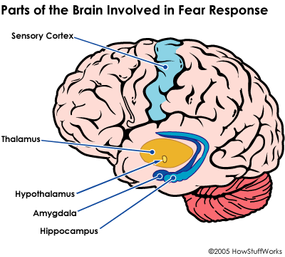
In 2023, I was traveling to India, sitting in the Mumbai airport waiting for my next connecting flight. It had been a long 20-something hours of nonstop traveling when a security guard approached me and asked me to follow him. I did not know why. I just followed him down through elevators, through hallways, deeper into the heart of the airport, until we reached a small, secluded room. An interrogator was waiting. She asked me what was in my bag in the tone that you know you’re in deep trouble. I had no idea what she was talking about. When they scanned my bag something set off their security system. She turned the screen toward me. There, in the X-ray image, was the unmistakable shape of a bullet in my bag. She asked me again, but this time more sternly, ”what is in your bag?” My chest tightened before my mind had even caught up to what I was looking at. My mind started running through every possibility at once…. Had someone planted something in my luggage? Was this some kind of setup? This couldn’t be possible. There was no way a bullet gets past TSA in the United States, survives an international flight, and only gets flagged by customs in another country. And yet there it was on the screen? How did this happen? They systematically placed everything out of the bag and put it on the table and told me to find the bullet. While I was frantically searching, she asked me again what I was hiding in my bag. This could not be happening to me and felt like a scene out of a movie. I could not find anything so their security worked through my bag scanning one piece at a time. I sat there and thought about what happens to the foreigner who brings in a bullet in their bag? They surely get detained … how long would that take in India? Do I need a lawyer? There was nothing to do but wait and watch. Finally, they found it. Inside this small compartment of my bag was a set of very old HONDA lawnmower keys. The metal was somehow shaped in just the right way that it looks just like a bullet casing on x-ray. What in the world? They didn't believe it and kept scanning items to find the bullet. They swabbed everything for gunpowder and who knows what else. Double checked everything. And eventually, I was allowed to go after signing their paper log book that looked like it was from the 1980’s. I guess that's how they'd track me down if they found something else wrong? I was relieved to leave, but in that room I was afraid. What I felt in that room was fear. Real, immediate, specific fear. And it was gone almost as fast as it arrived. As a counselor I talk to a lot of clients about fear, anxiety, worry, and stress almost as interchangable words. However, we need to draw a distinction because the brain doesn't process them the same. The Brain Doesn’t Actually Experience Fear and Anxiety the Same WayFear is your response to a real, identifiable threat that is happening right now. A security officer asking you to follow him. A car swerving into your lane. A dog charging at you. Fear has an object. It is about something specific, present, and (usually) time-limited. Anxiety is different. Anxiety is the anticipation of a threat that has not happened yet, might not happen at all, and often cannot even be clearly named. It is vague. Typically future-focused. Here is what is happening in your brain during each one. Your amygdala is the structure responsible for detecting threat and triggering your immediate reaction. It fires fast, before you even consciously register what is happening. This is what activated in that room in Mumbai the moment I saw the image on the screen.
But your amygdala does not work alone. Your hippocampus and prefrontal cortex are supposed to step in immediately after and provide context. The hippocampus pulls in memory, helping you evaluate whether this situation is actually dangerous based on past experience. The prefrontal cortex handles reasoning and judgment, helping regulate the emotional surge the amygdala just triggered. In a genuine fear response, this system works the way it is supposed to. Amygdala fires, prefrontal cortex evaluates, resolution happens, the nervous system calms back down. Anxiety is a bit different... Research on the neural circuitry of anxiety has found that in people struggling with chronic anxiety, the connectivity between the amygdala and the prefrontal cortex weakens. The rational part of the brain that is supposed to step in and calm things down loses some of its ability to override the automatic emotional reaction. The amygdala keeps firing. The threat never gets resolved because there was never a specific, locatable threat to resolve in the first place. Researchers have found that repeated activation of this fear circuitry actually reinforces the neural pathways associated with stress, making it easier for anxiety to activate the next time. Chronic anxiety can alter the brain’s actual structure and chemistry, including lower serotonin and dopamine, and elevated norepinephrine keeping you in a near-constant state of alertness. In other words, unresolved anxiety trains your brain to expect a threat that is not there. It becomes a habit and you can become more of an anxious person. A Tool for the Moment Anxiety Shows UpHere is one of the most well-researched tools for interrupting this cycle, and it is far simpler than most people expect. It is called affect labeling. Simply put: naming what you are feeling, out loud or in writing, in a specific & concrete way. A study by UCLA researcher Matthew Lieberman found that when people looked at emotionally distressing images and simply labeled the emotion they were experiencing, such as saying “I am feeling anxious” instead of just sitting in the feeling, their amygdala activity measurably decreased. Later studies confirmed the same pattern using brain imaging. The act of putting a feeling into words activated the prefrontal cortex and, in turn, quieted the amygdala. Here is what is remarkable about this. Most people assume you need to think your way out of anxiety with some complicated mental strategy. Labeling does not require that; it simply requires naming the emotion accurately. “I am feeling anxious about tomorrow’s meeting” does more to calm your nervous system than trying to white-knuckle your way past the feeling or pretend it is not there. When you notice anxiety rising, do not just try to push through it. Pause and name it specifically. Not “I feel bad.” Something more precise. “I am feeling anxious that my son is struggling at school and I do not know how to help him.” “I am feeling anxious about whether I said the wrong thing in that conversation.” The more specific the label, the more it engages the regulating part of your brain. If you can, say it out loud or write it down. Both work. Writing has the added benefit of slowing you down enough to find the actual words. Last thoughts... I think about that room in Mumbai sometimes, and what strikes me most is how clean the fear was. It arrived, it did its job, and it left. My body knew exactly what to do with it. Most of what I sit with in the therapy room is not that. It is the anxiety that has no clear definition. Give your brain something to work with. Stay connected, Zach Clinical Therapist and Founder of Mental Health 4 Men If you want to get the full library of guides/worksheets upgrade to the paid version!
|
Mental Health 4 Men
This newsletter is designed to give you researched backed skills to improve your mental, emotional and relational lives.
If you want to get the full library of guides/worksheets upgrade to the paid version! Upgrade Membership The 5 Most Common Regrets Dads Have With Their Kids Hey all, Over the years I have had a lot of dads sit in my office and talk about their kids. My job has allowed me a window in every type of family structure I can imagine. Some Dads come in when their kids are young, trying to figure out how to be more present, how to manage the stress they are bringing home, how to show up better for...
If you want to get the full library of guides/worksheets upgrade to the paid version! Upgrade Membership At Least It Wasn't Number Two We are potty training at the Werhan house... For those of you who have been through this, you already know what that means. For those of you who have not, let me paint you a picture... I was walking past the bathroom back into my room when I noticed water gushing out of the hallway bathroom. Initially, every bad thought/word went through my mind as I opened...
If you want to get the full library of guides/worksheets upgrade to the paid version! Upgrade Membership What is the habit you most want to break right now? Hey all, Let me tell you about one of the most common things I see when people are trying to break a bad habit. Most of the time, it is not really about the habit itself. The guy who cannot stop drinking at night may not actually be addicted to bourbon, but rather the stress reliever that comes after a long day. The bourbon is just what...